Balita Heriniaina Rakotonarivo: Senior Validation and QA Engineer
This portfolio is a solo project where the testing lifecycle is a primary deliverable. I carry out multiple roles from Test Manager and Test Analyst to Automation Engineer, to ensure full lifecycle coverage. Furthermore, I align my documentation and processes with ISO 29119 and ISTQB standards.
This portfolio serves as a comprehensive demonstration of my ability to:
Define and execute a robust Quality Assurance (QA) strategy in resource-constrained environments.
Implement professional-grade validation processes aligned with ISTQB standards.
Balance rapid delivery with high-quality standards for critical business paths.
Master United Nations (UN) standards for internationalization (i18n) and accessibility (a11y).
Architect, develop, and validate software solutions based on modern web technologies.
Design, build, and deploy interactive training materials adaptable to beginner, intermediate, and advanced levels in QA.
While this portfolio demonstrates a high-tech autonomous delivery, my professional identity is rooted in collaborative, large-scale international environments, including experience within tier-1 global corporation.
The WUT (Website-Under-Test) is a complex web application built with a modern stack (TypeScript, Next.js, PostgreSQL), specifically architected as a "Real-World" testing environment. This project is a dual-purpose demonstration of senior-level validation strategies and my proficiency in modern web technologies. While the WUT is built using a robust stack, it features a wide range of intentional defects, spanning Functional, Security, Accessibility, Usability, and Aesthetics to serve as a realistic testing workbench.
Educational & Training Value
Beyond a simple demo, the WUT is a transparent tool designed to upskill different profiles:
For Beginners: A practical introduction to ISTQB terminology within a real-world multilingual application.
For Advanced Profiles: A sandbox to:
Analyze, design, implement, and execute complex test cases from this test basis
Practice defect detection through Exploratory Testing.
Repair broken CI/CD pipelines and automate new tests.
Fix security vulnerabilities and accessibility violations, then perform confirmation and regression tests.
Study Specification-by-Example documents and implement Acceptance Test-Driven Development (ATDD) using Gherkin
To maintain the integrity of this technical demonstration, the repository is currently private. I have scheduled a public release for later this year. I would be glad to walk you through the test architecture, test basis, testware, Gherkin specifications, and CI/CD pipeline during our interview.
You will find the link to the deployed live application at the end of the page.
Zero-Budget Tooling Strategy
The project demonstrates the ability to architect a professional-grade QA lifecycle using exclusively Free-Tier and Open-Source resources without compromising quality standards. This is a demonstration of Frugal Engineering.
Human & Digital Resources
The testing effort is led by a Senior Validation and QA Engineer, augmented by a Multi-LLM and Local SLM approach. This Human-AI teaming strategy serves as a cost-free peer-review mechanism to mitigate solo-resource bias and takes advantage of AI while minimizing ecological footprint.
This model aligns with the ISTQB® Certified Tester – Testing with Generative AI (CT-GenAI) standards (launched in 2025), validating the operational integration of AI into professional QA workflows.
Infrastructure & Tooling
Web & Database Hosting: Leveraging Free-Tier cloud providers (GitHub, Vercel, Supabase) for 24/7 availability.
Testing Infrastructure: Local execution environments combined with open-source browser tools.
CI/CD Pipeline: GitHub Actions workflows.
AI Ecosystem: Gemini (Free Tier), Mistral (Free Tier), and locally deployed Ollama + Qwen for confidentiality, data privacy and ecological optimization.
Specialized QA Toolset
Specification-by-Example: Gherkin and VS Code specialized extensions.
Acceptance TDD: Cucumber / Behave.
Security: Open-source OWASP security engine.
Accessibility (a11y): Open-source audit engines (Axe-Core) for WCAG compliance.
Automation & API: Custom scripts in Python and TypeScript; Playwright, Bruno, and Selenium for regression testing.
Test Work Products: Markdown-based documentation.
Result: 0€ Infrastructure & Licensing Cost, proving that Senior-level Validation is driven by strategic resource optimization, not budget.
While I am fluent in enterprise suites like Atlassian (Jira, Confluence) or Gitlab, the deliberate choice of raw Git and Markdown demonstrates authentic skills in Test Management as Code and documentation versioning.
Testware
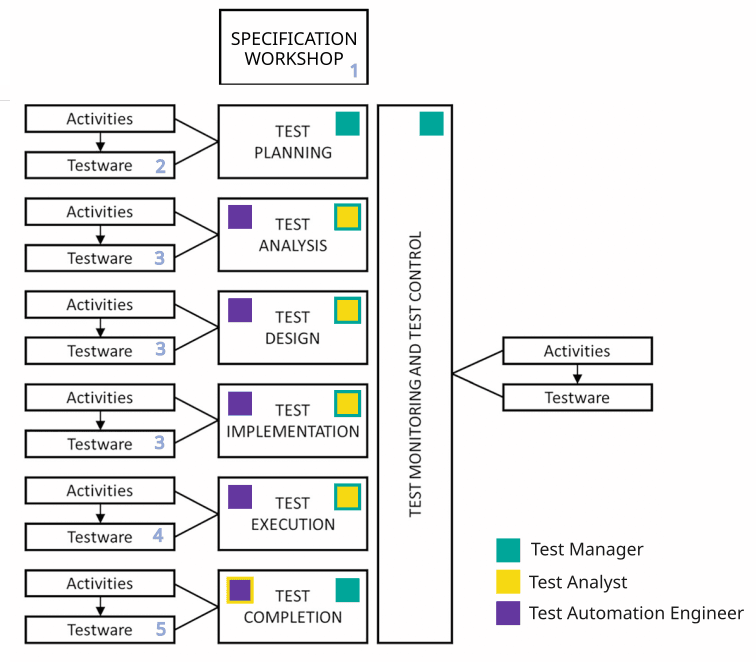
Testware in relation with the activities I executed for this portfolio.
In this solo-resource context, the documentation strategy is tailored for maximum efficiency based on ISO 29119-3 Standard. I have prioritized high-value artifacts that directly support quality and technical validation, while bypassing administrative reporting and monitoring formalisms that are redundant in a standalone workflow.
User stories: Specification-by-Example feature files [1].
Planning: Comprehensive Test Plan [2] including Risk Register, Risk Traceability Matrix, Entry Criteria, and Exit Criteria.
Monitoring & Control: Activities are handled dynamically through Git versioning and task tracking. Formal Test Progress Reports and control directives are bypassed to prioritize execution and delivery.
Analysis, Design & Implementation: Detailed Test Cases [3].
Execution: Test Logs integrated within test cases [3] and Defect Management Dashboard [4].
Completion:Test Summary Report [5], providing a final quality assessment.
Professional Background & Global Expertise
I would like to highlight key pillars of my journey that define my strategic approach to Quality and Validation:
International Communication: Native French speaker with C2-level proficiency in English, accustomed to high-level technical and strategic reporting in multicultural environments.
Operational Software Delivery: Served at ASECNA (Africa's leading Air Navigation Service Provider) for 12 years, managing a weather station and developing software solutions to support AFIS (Aerodrome Flight Information Service) and the digitalization of manual processes for operational aeronautical meteorologists.
Proven Leadership: Led a multidisciplinary team of 7 professionals for 8 years at an international airport weather station, ensuring 24/7 operational integrity while applying ISO 9001 quality management standards to station operations and team leadership.
Senior Engineering at Scale: Recently served as Senior Engineer at Collins Aerospace | an RTX Business in Cork, Ireland. As a Principal Investigator, I worked with agile methodologies on an international team spanning three time zones, specializing in Drone Operations Management software.
Applied Research & Innovation: Contributed for 6 years to the École Nationale de l'Aviation Civile (ENAC) as a Researcher and Software Engineer, participating in French and European research projects about Drone Mission Preparation software, besides refactoring the legacy Advanced Surface Movement and Control System (A-SMGCS) simulator.
Mentoring: I taught Cybersecurity and Machine Learning to engineering students at Aviation Schools in Toulouse, France.
My background enables me to lead validation strategies that bridge the gap between technical rigor and international business requirements.